Seasonal · Ocean

Oʻahu whale watching

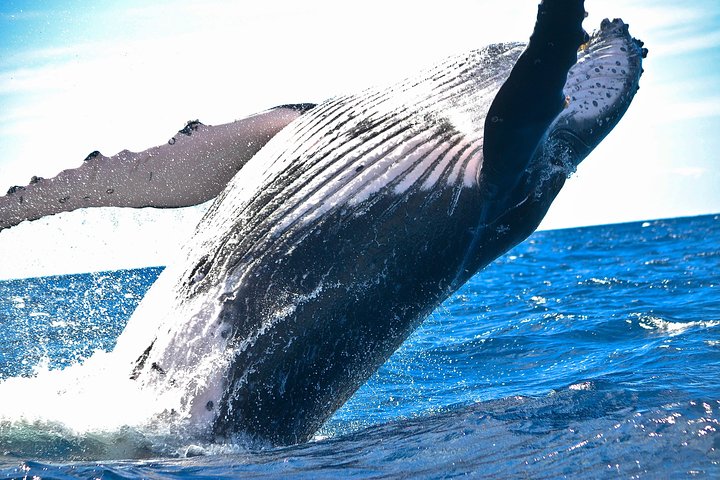
Humpback whales are in Hawaiian waters from roughly December through April, peaking January to March, and Oʻahu boats run two-hour trips out of Waikīkī and Kewalo Basin during that window only. Federal law keeps every boat 100 yards off, so no operator can put you closer — what you are paying for is a captain who knows where the whales were this morning. If whales are the whole reason for your trip, Maui's ʻAuʻau Channel is materially better water.

Msg & data rates may apply. Text STOP to opt out, HELP for help.

Every winter, several thousand humpback whales leave their feeding grounds off Alaska and swim roughly 3,000 miles to Hawaiʻi to breed and give birth. They are called koholā in Hawaiian, they arrive with the first cold snaps up north, and they leave again in spring. The whole reason this happens here is that the water between the islands is warm, shallow and calm enough for a newborn calf that has no blubber yet.

That migration is the single most reliable wildlife event in the islands — and it is also the thing most likely to be misrepresented to you, because the season is short and the demand is not. Here is what is actually true about it.

The season is real, and it is not year-round

Humpbacks begin arriving in November, build through December, and the population peaks in January, February and March. Numbers fall off through April and the last stragglers leave in May. Most Oʻahu operators sell whale trips from about mid-December to mid-April, and run the same boats as snorkel sails and sunset cruises for the rest of the year.

If you are reading this in summer or early autumn, there is nothing to book. That is not a scheduling problem you can solve by paying more or looking harder — the whales are in Alaska. Any listing selling you a July whale watch on Oʻahu is selling you a boat ride. Come back in December, or take a snorkel trip or a sunset sail instead, which is what those same crews are doing right now.

The 100-yard rule, and why it matters to what you book

In Hawaiian waters it is federal law that vessels stay at least 100 yards from a humpback whale. This is not a guideline and not an operator policy — it applies to every boat on the water, from the cheapest six-pack to the largest catamaran. Captains approach to the line, cut the engine, and wait.

Two things follow from that, and they should change how you shop. First, nobody can sell you proximity. A more expensive trip does not get you closer; it gets you a better boat, a smaller group, shade, a bathroom you would willingly use, and usually a naturalist who can tell you what you are looking at. Second, the rule constrains the boat and not the whale. Curious juveniles and unbothered mothers approach stationary vessels regularly, and when it happens it happens well inside 100 yards. That is the trip everyone remembers, and no one can promise it.

What a “guaranteed sighting” is worth

Several Oʻahu operators advertise guaranteed sightings. Read it carefully: in almost every case the guarantee is a free second trip, not your money back. In peak season it is a safe promise for the operator to make and a fair one — the channel really is that reliable in February.

It is worth much less than it sounds if you are on the last day of your holiday, or if the policy requires you to re-ride within the same season and you are flying home. If a guarantee is the reason you are choosing one boat over another, book it early in your trip so the guarantee is something you could actually use.

Where the boats go from Oʻahu

  • Waikīkī and Ala Wai Harbor — the convenient option, walking distance from most Waikīkī hotels. Boats run south and west along the coast. Two hours is the standard trip and it is genuinely two hours, not ninety minutes with a sales pitch.
  • Kewalo Basin — ten minutes from Waikīkī, next to Ala Moana. A working harbour with a wider range of vessels, including the larger catamarans that handle chop better.
  • West Oʻahu and Ko Olina — a longer drive from Waikīkī, and usually calmer, clearer water in the lee of the island. Worth it if you are already staying on that side or if seasickness is a real concern. Pair it with the Ko Olina area for the day.

Maui is better, and you should know that before you book

The ʻAuʻau Channel — the sheltered stretch between Maui, Lānaʻi and Molokaʻi — is where the highest concentration of mothers and calves spends the winter. It is shallow, it is protected from the trades on most sides, and in peak season you can stand on the beach at Lahaina or Kīhei and count blows. It is, straightforwardly, the best whale watching in the state.

We are an Oʻahu-based operation and we would still rather tell you that than sell around it. If whales are the reason for the trip and you can get to Maui, go: see Maui tours and the Kīhei guide. If you are staying in Waikīkī with two spare hours and a winter morning, the Oʻahu trips below are a genuinely good use of them — the whales are here too.

Picking a boat

  • Go in the morning. Trade winds build through the day. A morning departure is a flatter ride, which matters more than anything else on this list if anyone in your group is prone to seasickness.
  • Bigger is steadier. A large catamaran moves less than a small boat in the same swell. Small boats get you a smaller group and a more personal trip, and they move a lot.
  • Check whether a naturalist is aboard. On a stationary boat 100 yards from a whale, the difference between a good trip and a great one is usually someone explaining what that behaviour means — why she is slapping her pectoral fin, why there are three males following one female.
  • Take the medication before you board. An hour before, not when you start to feel it. By then it is too late.

Seeing them for free

You do not need a boat. From roughly January to March, elevated south- and east-facing lookouts on Oʻahu produce whales regularly on a clear morning: Diamond Head Lookout, Makapuʻu Point along the windward coast, and the Lānaʻi Lookout on the Kalanianaʻole Highway. Bring binoculars, give it twenty patient minutes, and watch for the blow rather than the body — a column of spray is what you will spot first, and it hangs in the air for a few seconds.

A boat buys you two things the shore cannot: distance closed, and sound. On a quiet boat with the engine off you can sometimes hear a male singing through the hull.

Bookable experiences

2-Hour Oahu Whale Watch from Ala Wai Harbor, WaikikiExperience Great value

2-Hour Oahu Whale Watch from Ala Wai Harbor, Waikiki

Viator

2hBest: any4.6(1,963 reviews)
whale watching

from $43

via viator

Book Now
Details & photos
Luxury Snorkel Cruise, Local Buffet with Whale & Dolphin WatchOcean

Luxury Snorkel Cruise, Local Buffet with Whale & Dolphin Watch

Viator

3.5hBest: any4.7(1,360 reviews)
snorkelwater

from $174

via viator

Book Now
Details & photos
Waikiki, Oahu 2-Hour Whale Watching: Guaranteed SightingsExperience Great value

Waikiki, Oahu 2-Hour Whale Watching: Guaranteed Sightings

Viator

2hBest: any4.6(1,190 reviews)
whale watching

from $45

via viator

Book Now
Details & photos
Waikiki Deluxe Catamaran Whale WatchExperience

Waikiki Deluxe Catamaran Whale Watch

Viator

2hBest: any4.5(649 reviews)
whale watching

from $89

via viator

Book Now
Details & photos
Honolulu: Oahu Whale Watching Boat TourOcean

Honolulu: Oahu Whale Watching Boat Tour

GetYourGuide

2hBest: any4.5(479 reviews)
whale-watchingwater

See pricing

via gyg

Book Now
Details & photos
Best Waikiki Whale Watching in Honolulu: Whales GuaranteedExperience

Best Waikiki Whale Watching in Honolulu: Whales Guaranteed

Viator

2hBest: any4.6(226 reviews)
whale watching

from $79

via viator

Book Now
Details & photos
Whale Watch Cruise Aboard The MajesticExperience

Whale Watch Cruise Aboard The Majestic

Viator

2.5hBest: any4.5(195 reviews)
whale watching

from $85

via viator

Book Now
Details & photos
2 Hour Waikiki Whale Watching Cruise from OahuExperience Great value

2 Hour Waikiki Whale Watching Cruise from Oahu

Viator

2hBest: any4.6(171 reviews)
whale watching

from $40

via viator

Book Now
Details & photos
Honolulu, Oahu: Waikiki Whale Watching CruiseExperience

Honolulu, Oahu: Waikiki Whale Watching Cruise

GetYourGuide

1.5hBest: any3.8(167 reviews)
whale-watching

See pricing

via gyg

Book Now
Details & photos
Oahu: Waikiki Eco-Friendly Morning Whale Watching CruiseExperience

Oahu: Waikiki Eco-Friendly Morning Whale Watching Cruise

GetYourGuide

2hBest: any4.4(119 reviews)
whale-watching

See pricing

via gyg

Book Now
Details & photos
Sunset Whale Watch in Waikiki, Whales Guaranteed or Free ReturnEvening Top rated

Sunset Whale Watch in Waikiki, Whales Guaranteed or Free Return

Viator

1.5hBest: any4.8(107 reviews)
whale watchingevening

from $54

via viator

Book Now
Details & photos
West Oahu Deluxe Whale Watching SailOcean

West Oahu Deluxe Whale Watching Sail

Viator

2hBest: any4.7(74 reviews)
whale watchingwater

from $89

via viator

Book Now
Details & photos

FAQ

When is whale watching season in Hawaiʻi?
Humpbacks arrive from Alaska through November and December, peak in January, February and March, and thin out through April. Most Oʻahu operators run whale trips from roughly mid-December to mid-April and switch those same boats to snorkel and sunset sailings the rest of the year. Outside that window there are no whale tours to book, not because operators are sold out but because the whales are 3,000 miles north.
How close do the boats get to the whales?
No closer than 100 yards. That is federal law in Hawaiian waters, not an operator preference, and it applies to every boat regardless of what the listing costs. Captains cut the engine and wait. What the rule does not prevent is a whale choosing to approach the boat, which happens often enough that most trips get a good look — it just is not something anyone can promise in advance.
What does a whale sighting guarantee actually mean?
It means a free second trip, not a refund and not a guarantee that you will see a whale. Operators offering it are making a bet on how reliable the peak-season channel is, and it is a reasonable bet. Read the specific policy before booking: some require you to re-ride within the same season, and a guarantee is worth much less on the last day of your trip than on the first.
Is Maui better than Oʻahu for whale watching?
Yes, and it is not close. The ʻAuʻau Channel between Maui, Lānaʻi and Molokaʻi is shallow and sheltered, and it is where the largest concentration of mothers and calves settles for the winter. If whales are the reason for your trip and you can reach Maui, go there. Oʻahu whale watching is genuinely good and it is two hours from Waikīkī rather than a day and a flight — that is the actual trade.
What time of day is best for a whale watching trip?
Morning, for water conditions rather than whale behaviour. Trade winds usually build through the afternoon, so a morning departure is a flatter ride and an easier one if anyone in your group is prone to seasickness. Whales do not keep a schedule. Afternoon and sunset whale sails trade some comfort for better light.
Will I get seasick?
Some people will. These are open-ocean trips on boats that stop and sit while everyone watches, which is the motion that causes trouble. If you are unsure, take medication an hour before boarding rather than after you feel it, pick a morning departure, stay on deck where you can see the horizon, and choose a larger catamaran over a small boat.
What else will I see besides humpbacks?
Spinner dolphins are common year-round off the south and west shores, green sea turtles surface regularly, and flying fish scatter ahead of the hulls. In season you may also see pilot whales or false killer whales. None of that is guaranteed either, but it is why the trip is rarely a bust even on a quiet whale day.
Can you see whales from shore on Oʻahu?
Yes, and it costs nothing. In peak season, elevated south- and east-facing spots — Diamond Head Lookout, Makapuʻu Point, the Lānaʻi Lookout — regularly produce blows and breaches on a clear morning. Bring binoculars and give it twenty patient minutes. A boat gets you closer and gets you the sound; the shore gets you the season for free.

Prefer to text? Get instant Oʻahu recs by SMS — Text ALOHA to (808) 825-6421

Msg & data rates may apply. Text STOP to opt out, HELP for help.